FREE SHIPPING ON ALL BUSHNELL PRODUCTS

Leave Your Message
Choosing the best sanding belt in 2026 is not just a matter of picking the roughest grit or the lowest price. Sanding Belts For Belt Sanders need to match the tool’s belt size, the material, and the finish you want. A belt that fits poorly can track unevenly, wear quickly, or leave marks that take extra work to remove.
This guide explains how to compare belt materials, grit ranges, backing types, and common belt sizes. It also looks at choices for wood, metal, paint removal, and general workshop jobs. Coarse grits remove material quickly, while finer grits help refine a surface. But those labels do not tell the whole story. Bond quality, heat buildup, and how steadily the belt runs matter too. Small details count.
There is no single best belt for every project. A durable ceramic belt may make sense for demanding stock removal, while aluminum oxide can be a practical choice for routine sanding. Check your sander’s manual for the required belt dimensions and follow the abrasive maker’s guidance for suitable materials and speeds. If a belt clogs or leaves deep scratches, the grit or technique may be wrong; sometimes both are. This comparison focuses on useful selection criteria rather than promising one product will solve every problem. Weigh specifications against your actual workload, and treat unusually broad performance claims with care. A little trial and adjustment are part of sanding.
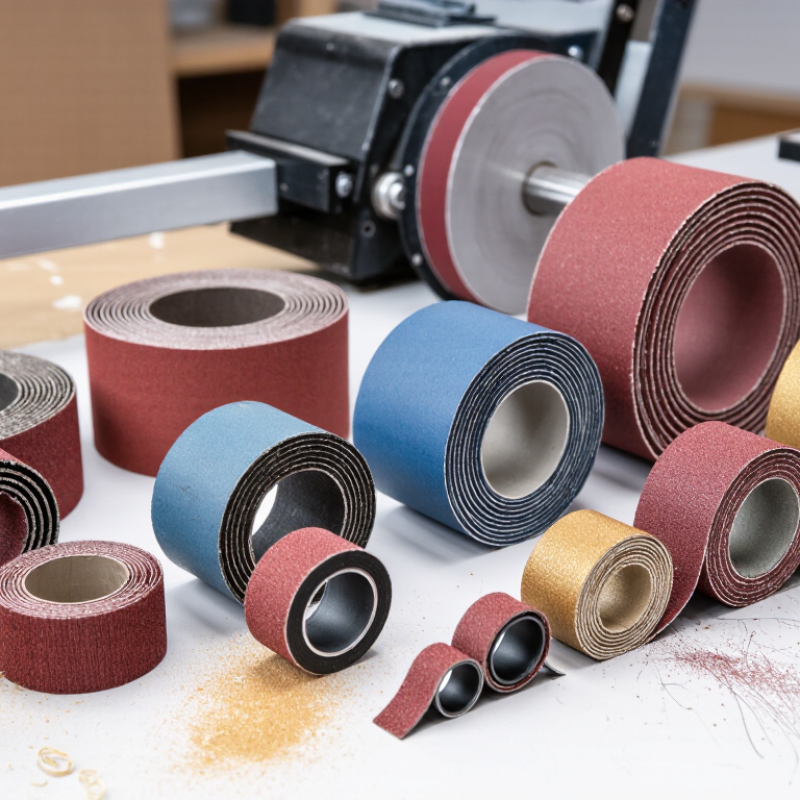
On a belt sander, grit number describes abrasive grain size, not cutting speed alone. FEPA’s P-grade sizing data puts P24 at a median grain size of about 764 microns and P400 at about 35 microns. That is nearly a 22-fold difference in diameter. Coarse belts remove material quickly, but leave deeper scratches. Coarse cuts fast. P24–P60 suits rapid shaping and heavy stock removal; P80–P120 is more controlled for flattening and routine sanding. These are starting points, not fixed rules.
For wood, P180–P240 can refine a surface before many finishes, while P320–P400 may help with finer smoothing. Small steps matter. Moving directly from P80 to P240 can leave scratches that only show under low, angled light. Check the surface as you work, and reduce pressure if the belt begins to heat or load with dust. On some hardwoods, very fine sanding can burnish the grain and affect stain absorption; it is easy to overdo. Material, belt condition, and pressure all change the result. FEPA grading tables describe grain size, not the finish a particular belt will produce.
| FEPA P-Grade | Approx. Particle Size (µm) | Relative Cut | Typical Belt-Sanding Use | Practical Guidance |
|---|---|---|---|---|
| P24 | 764 | Very coarse | Rapid stock removal on suitable, robust workpieces | Leaves deep scratches; use only when substantial material removal is intended. |
| P30 | 642 | Very coarse | Heavy shaping and initial leveling | Check the surface frequently to avoid gouging or removing too much material. |
| P36 | 538 | Very coarse | Fast removal of rough surface material | Follow with progressively finer grades before finishing. |
| P40 | 425 | Coarse | Initial sanding of rough wood or removing stubborn surface irregularities | Use controlled passes; coarse scratches can be difficult to remove later. |
| P50 | 336 | Coarse | Early-stage sanding and leveling | Suitable where a strong cut is needed, but not for final surface preparation. |
| P60 | 269 | Coarse | General rough sanding and removing visible machining marks | Inspect the scratch pattern before moving to a finer grade. |
| P80 | 201 | Medium-coarse | Shaping and first refinement after heavy sanding | A common transition grade for preparing a surface for finer sanding. |
| P100 | 162 | Medium | Refining a surface after coarse sanding | Useful for continued scratch removal; results vary with material and sanding pressure. |
| P120 | 125 | Medium | General-purpose smoothing on many wood surfaces | Often used before finer preparation, depending on the intended coating or finish. |
| P150 | 100 | Medium-fine | Further smoothing and preparation for some finishes | Keep the belt moving to reduce the chance of uneven marks. |
| P180 | 82 | Fine | Fine surface preparation and scratch refinement | Check coating or finishing instructions; some systems call for a coarser or finer final grit. |
| P220 | 68 | Fine | Fine sanding before many finishing steps | Generally suited to light refinement rather than rapid stock removal. |
| P240 | 58.5 | Fine | Light smoothing and fine scratch reduction | Use a light touch; belt sanders remove material quickly even at finer grades. |
| P280 | 52.2 | Very fine | Fine surface refinement where the material and finish allow | Confirm that this grade is appropriate for the next finishing step. |
| P320 | 46.2 | Very fine | Light finishing preparation and controlled fine sanding | Not typically chosen for fast leveling or heavy material removal. |
| P360 | 40.5 | Very fine | Fine refinement on compatible surfaces | Use only when the required finish benefits from this fine a scratch pattern. |
| P400 | 35.0 | Very fine | Very fine sanding and finish-specific preparation | Check the finish maker’s recommendations; a belt sander may be aggressive for delicate final work. |
Reading the table: Particle sizes are approximate FEPA P-grade reference values in micrometres, not a guarantee of the exact grain size or sanding result on a particular belt. Lower P-numbers are coarser and generally cut more aggressively; higher P-numbers are finer. Choose belt dimensions and abrasive type to match the sander, workpiece, and task, and follow the tool and finish instructions. Wear suitable eye and respiratory protection, and control dust.